

Free tool
Team capacity calculator
Free capacity is what your team can bill at target utilization, minus work already booked. See it in hours and in people before you sign new work.
Last updated · Read as Markdown

Capacity calculator
Team total days
Confirmed and likely work
Free billable capacity
343 h
About 2.1 full-time people free for the period
- Gross capacity
- 2,400 h
- Net capacity after time off
- 2,304 h
- Billable capacity at target
- 1,843 h
- Planned utilizationAllocated ÷ net capacity
- 65.1%
Net capacity = people × hours × weeks − time off. Free capacity = net capacity × target utilization − allocated hours.
The formula
- Gross capacity
- People × weekly hours × weeks
- Net capacity
- Gross capacity − time off
- Billable capacity
- Net capacity × target utilization
- Free capacity
- Billable capacity − allocated hours
How to calculate team capacity
- 1.Start with gross capacity. People times contracted weekly hours times weeks in the period.
- 2.Subtract time off. Holidays, approved leave, and public holidays in the same period.
- 3.Apply target utilization. Nobody bills every hour. Multiply net capacity by target utilization to get billable capacity.
- 4.Subtract allocated work. Include confirmed projects and proposals you expect to win. What remains is free capacity.
Worked example
A 15-person team works 40 hours a week. Over 4 weeks that is 2,400 gross hours. With 12 days of time off, net capacity is 2,304 hours, and at 80% target utilization 1,843 hours are billable.
1,500 hours are already allocated, so the team has 343 free billable hours, about 2.1 full-time people for the period. A new project needing more than that means hiring, freelancers, or moving a deadline.
| Step | Calculation | Result |
|---|---|---|
| Gross capacity | 15 × 40 × 4 | 2,400 h |
| Net capacity | 2,400 − 12 days × 8 h | 2,304 h |
| Billable capacity | 2,304 × 80% | 1,843 h |
| Free capacity | 1,843 − 1,500 | 343 h |
Capacity planning that holds up
- Plan proposed work too. Pipeline deals you expect to win compete for the same people. Leaving them out makes capacity look larger than it is.
- Plan by skill, not just hours. Free design hours do not help a project that needs a developer. Break capacity down by role.
- Compare plan with actuals. Allocations drift. Compare planned hours with logged hours each week to see where the plan was wrong.
- Use the same period everywhere. Capacity, allocation, and time off must cover the same weeks.
The capacity planning glossary entry and the resource capacity planning guide cover the process in more depth.
In Pike
Capacity, live in Pike
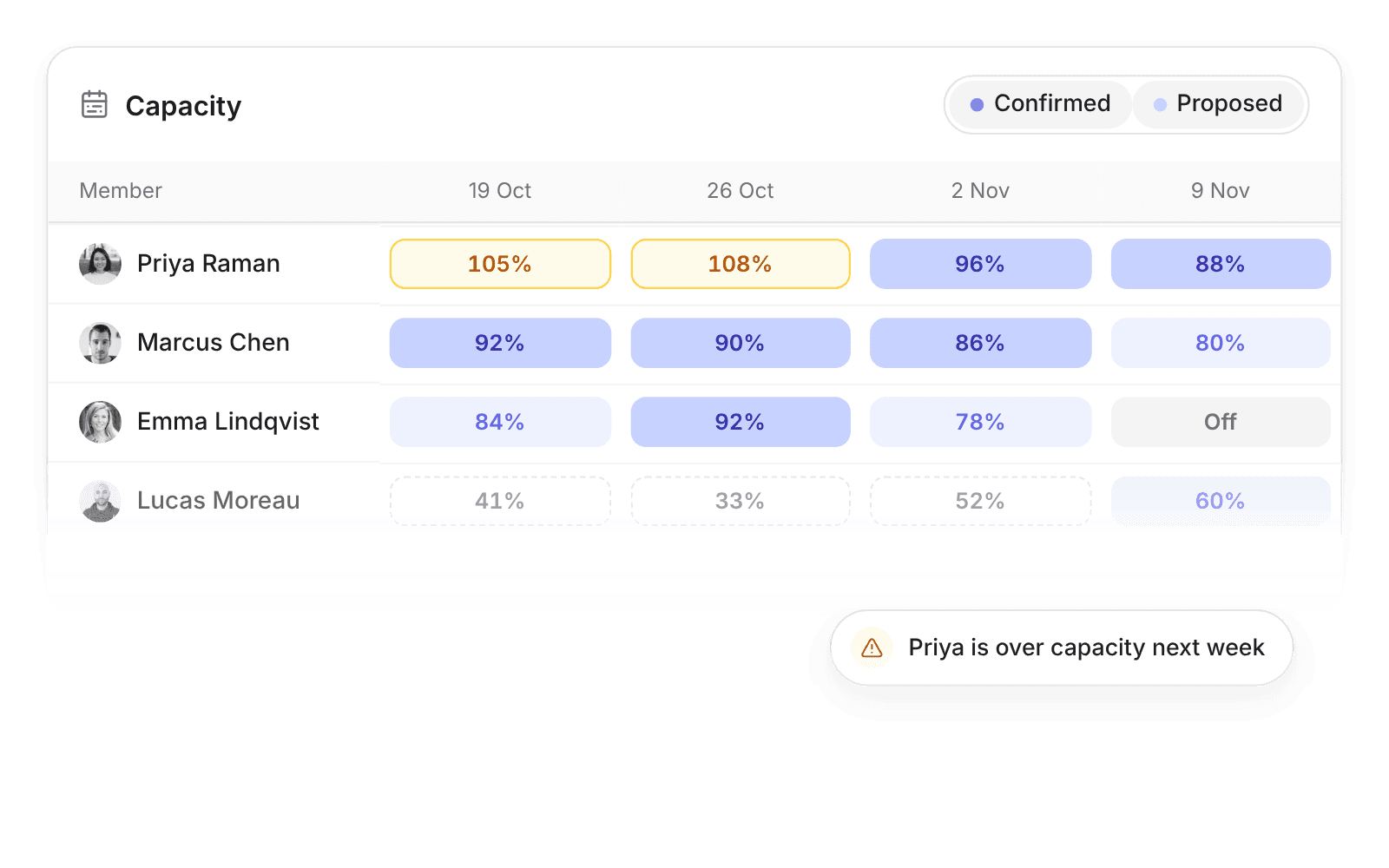
Confirmed and proposed work in one view, with time off.
Pike shows capacity by person and week, including tentative work from your pipeline and approved time off, so you know whether you can take on a client before you sign.
Capacity questions
How do I calculate team capacity?
Multiply people by weekly hours by weeks for gross capacity, subtract time off for net capacity, then multiply by target utilization for billable capacity. Subtract allocated hours to get free capacity.
What is the difference between capacity and utilization?
Capacity is the hours a team can work in a period. Utilization is the share of those hours spent on billable work. Capacity planning looks forward; utilization usually measures what already happened.
What is an FTE?
An FTE (full-time equivalent) is one person working full contracted hours. Free capacity divided by one person’s hours for the period gives free capacity in FTEs.
Should proposed projects count in capacity planning?
Yes, weighted by how likely you are to win them. Otherwise every new deal looks like it fits, and the team ends up overbooked when several close at once.
Know whether you can take the work before you sign.
 ISO 27001
 GDPR
 SOC 2 Type II
Built to keep sensitive client data secure and private.