

Free tool
Utilization rate calculator
Utilization rate is billable hours divided by available hours. Enter your team’s hours to see utilization, the gap to target, and what that gap costs.
Last updated · Read as Markdown

Utilization calculator
Team total: holidays, leave, sick days
Team total for the week
Billable utilization
72.4%
330 billable of 456 available hours
- Billable hours at target
- 342.0 h
- Shortfall against target
- 12.0 h / week
- Billable revenue this week
- $49,500
- Revenue left on the tableShortfall hours at your blended rate
- $1,800 / week
- Same gap over a year
- $82,800
Utilization = billable hours ÷ available hours. Available hours are contracted hours minus time off.
The formula
- Utilization rate
- Billable hours ÷ available hours × 100
- Available hours
- Contracted hours minus holidays, leave, and sick days
- Revenue gap
- Hours short of target × blended billing rate
- Definition
- See utilization rate and billable utilization in the glossary.
How to calculate utilization rate
- 1.Count available hours. Multiply people by contracted weekly hours, then subtract time off for the same week.
- 2.Count billable hours. Use hours logged to client work you can invoice, or that count against a fixed fee. Leave out internal meetings, sales, and admin.
- 3.Divide. Billable hours divided by available hours gives billable utilization.
- 4.Compare to target. Multiply available hours by your target percentage to get the billable hours you planned for.
Measure the same window for both numbers. Billable hours from one week against available hours from a month gives a figure that means nothing.
Worked example
A 12-person agency contracts 40 hours a week per person and has 24 hours of time off this week, leaving 456 available hours. The team logs 330 billable hours, so utilization is 72.4%.
Against a 75% target the team planned 342 billable hours, so it is 12 hours short. At a $150 blended rate that is $1,800 a week, or $82,800 over 46 working weeks.
| Step | Calculation | Result |
|---|---|---|
| Available hours | 12 × 40 − 24 | 456 h |
| Utilization | 330 ÷ 456 | 72.4% |
| Target hours | 456 × 75% | 342 h |
| Weekly revenue gap | 12 h × $150 | $1,800 |
How to set a utilization target
Set the target from your cost model, not from a benchmark. The billable rate calculator shows how utilization, salary, overhead, and margin fit together: the lower your utilization, the higher your rate has to be to hit the same margin.
Set targets by role. Partners and leads carry sales and management work, so their targets sit below those of delivery staff. One blended firm-wide target hides who is overloaded and who is on the bench.
What moves utilization
- Missing timesheets. Hours worked but not logged look like low utilization. Fix timesheet compliance before you change staffing.
- Bench time between projects. Plan proposed work alongside confirmed work so people are booked before a project ends. See capacity planning.
- Non-billable work on client projects. Rework, internal reviews, and unscoped requests use hours you cannot invoice. Track them as non-billable on the project so they show up.
- Utilization is not margin. A team can hit target utilization on discounted or over-serviced work and still lose money. Check project margin alongside it.
In Pike
Utilization, live in Pike
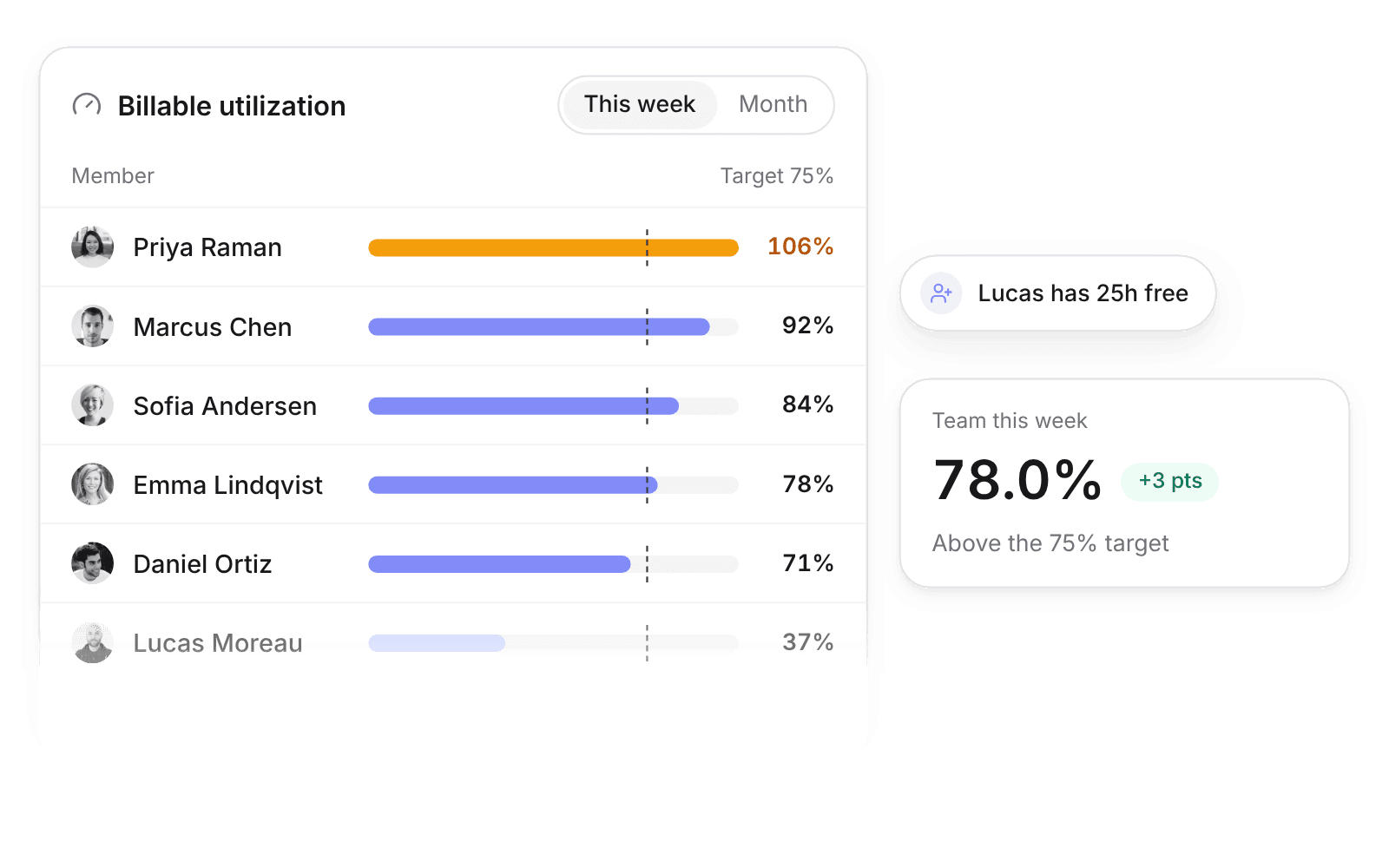
See who is over and under target this week, not at month-end.
Pike compares logged billable hours with each person’s contracted capacity and time off as people log time, so you can move work to whoever has room before the hours are lost.
Utilization rate questions
What is the utilization rate formula?
Utilization rate = billable hours ÷ available hours × 100. Available hours are contracted hours minus holidays, leave, and sick days for the same period.
What is the difference between utilization and billable utilization?
Total utilization counts all productive hours, including internal projects. Billable utilization counts only hours you can invoice or that count against a client fee. Agencies usually track billable utilization because it drives revenue.
Should time off count in available hours?
No. Subtract holidays, leave, and sick days from contracted hours. Otherwise a week with a public holiday looks like a utilization drop that nobody can fix.
Can utilization be too high?
Yes. Sustained utilization near 100% leaves no time for training, sales, or internal work, and usually means hours go unlogged or people burn out. Set the target from your cost model and leave room for non-billable work.
How is utilization different from realization rate?
Utilization measures how much time is billable. Realization rate measures how much of the billable value you actually invoice and collect after write-offs and discounts.

See utilization update as your team logs time.
 ISO 27001
 GDPR
 SOC 2 Type II
Built to keep sensitive client data secure and private.