

Free tool
Billable rate calculator
Your minimum billable rate is fully loaded cost divided by the hours you actually bill. Add your target margin to get the rate to charge.
Last updated · Read as Markdown

Billable rate calculator
Taxes, pension, benefits
Rent, software, admin, per year
After holidays and leave
Hourly rate for your target margin
$165
At 75% utilization and 50% gross margin
- Fully loaded cost per year
- $114,000
- Billable hours per yearof 1,840 available
- 1,380 h
- Cost per available hour
- $62
- Break-even billing rateCovers cost, zero margin
- $83
Break-even rate = fully loaded cost ÷ billable hours. Target rate = break-even rate ÷ (1 − target margin).
The formula
- Fully loaded cost
- Salary × (1 + employer cost %) + overhead per person
- Billable hours
- Weekly hours × working weeks × target utilization
- Break-even rate
- Fully loaded cost ÷ billable hours
- Rate for target margin
- Break-even rate ÷ (1 − target gross margin)
How to calculate a billable rate
- 1.Add up the full cost of a person. Salary plus employer taxes, pension, and benefits, plus a share of overhead: rent, software, finance, and admin staff.
- 2.Work out billable hours. Contracted hours times working weeks gives available hours. Multiply by target utilization to get hours you will actually bill.
- 3.Divide cost by billable hours. That is the break-even rate: every hour billed below it loses money.
- 4.Add margin. Gross margin is profit divided by revenue, so divide the break-even rate by one minus the margin. Adding 50% to cost gives a 33% margin, not 50%.
Worked example
A consultant earns $80,000. Employer costs add 20% and overhead adds $18,000, for a fully loaded cost of $114,000. At 40 hours a week for 46 weeks there are 1,840 available hours, and at 75% utilization 1,380 of them are billable.
Break-even is $83 an hour. To earn a 50% gross margin, bill $165 an hour.
| Step | Calculation | Result |
|---|---|---|
| Fully loaded cost | $80,000 × 1.2 + $18,000 | $114,000 |
| Billable hours | 40 × 46 × 75% | 1,380 h |
| Break-even rate | $114,000 ÷ 1,380 | $83 |
| Rate for target margin | $83 ÷ (1 − 50%) | $165 |
Common rate-setting mistakes
- Dividing salary by 2,080 hours. That assumes every working hour is billable and ignores employer costs and overhead. The result is a rate that loses money.
- Confusing markup with margin. A 50% markup on cost is a 33% gross margin. Price from the margin you want.
- One rate for every role. Seniors cost more and bill fewer hours. Use a rate card by role, then check the blended rate on each project.
- Ignoring write-offs. If you write off a share of hours, your realization rate lowers the rate you actually earn. Raise the rate or fix the scope.
In Pike
Rates and costs, live in Pike
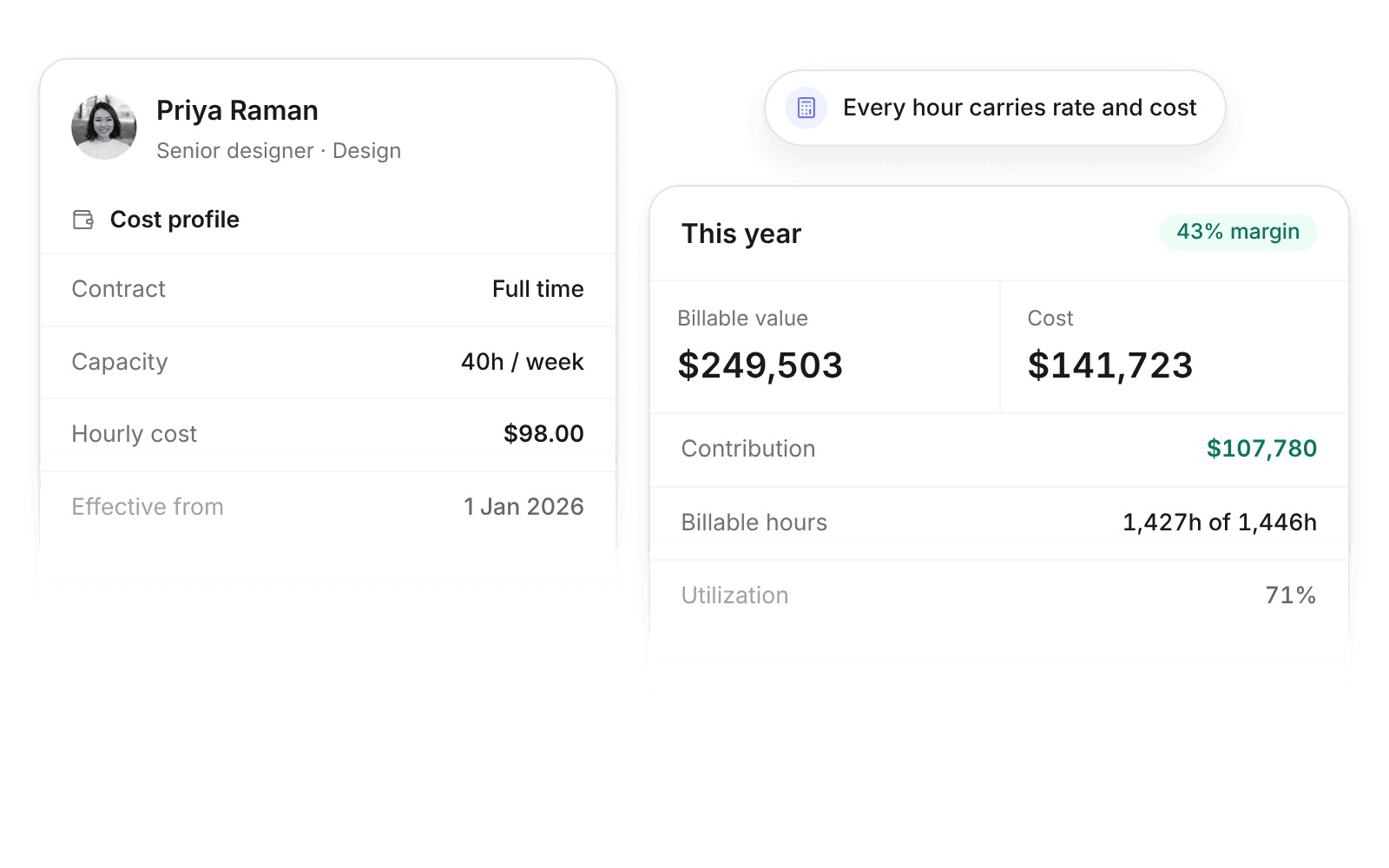
Every logged hour carries both its billing rate and its cost.
Pike stores a cost profile for each member, so billable value, cost, and contribution update as time is logged, by person, project, and client. Cost profiles and profitability are on the Growth plan.
Billable rate questions
How do I calculate my billable rate?
Add salary, employer costs, and overhead to get fully loaded annual cost. Divide by billable hours per year (available hours × target utilization) for the break-even rate. Divide that by one minus your target gross margin for your billing rate.
What is a fully loaded cost?
Fully loaded cost is salary plus employer taxes, pension, benefits, and a share of overhead such as rent, software, and admin staff. It is what a person really costs the firm each year.
What is the difference between markup and margin?
Markup is profit as a share of cost; margin is profit as a share of revenue. Pricing at cost plus 50% gives a 33% gross margin. To get a 50% margin, charge twice the cost.
How many billable hours are in a year?
It depends on contracted hours, leave, and utilization. 40 hours a week for 46 working weeks is 1,840 available hours; at 75% utilization that is 1,380 billable hours.

Price work on real cost data, not guesses.
 ISO 27001
 GDPR
 SOC 2 Type II
Built to keep sensitive client data secure and private.