


Project profitability report: template, columns and examples
 Daniel Reyes
By Daniel Reyes
Content Writer at Pike
Share

A marketing agency bills a client $50,000 in a month and keeps $7,000 of it. Measured against total billings, that is a 14% margin and looks like a failing account. Measured against the money the agency actually earned for its own work, it is a 35% margin and one of the healthier clients on the books. Both numbers come from the same invoice, and only the second one is useful for running the business.
Marketing agency profitability is the margin your agency keeps on its own work after delivery costs, measured per client and per month. Two things make it harder to measure than in most service businesses: media and other pass-through costs inflate revenue, and retainers hide how many hours each client really takes.
This guide covers how to calculate profitability correctly, the three places margin usually leaks in a marketing agency, and a monthly review that catches the leaks while you can still act on them.
Measure margin against agency gross income (AGI), which is total billings minus pass-through costs. Pass-through costs are money you collect from the client and pay straight out to someone else: ad spend, paid media, printing, influencer fees, third-party tools billed at cost.
Pass-through money passes through your books, but your team does not earn it. Including it in revenue makes every media-heavy client look less profitable than a client who buys only services, even when the opposite is true.
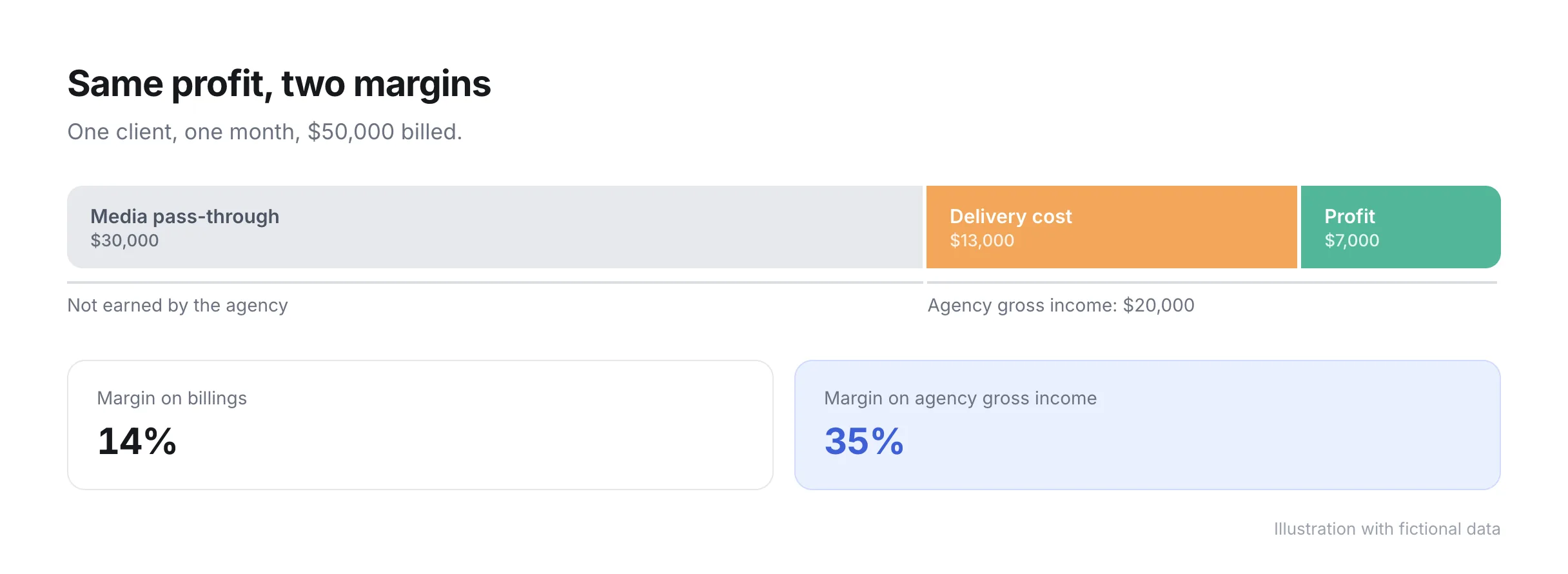
Using the example above:
| Measure | Amount |
|---|---|
| Total billings | $50,000 |
| Media pass-through | $30,000 |
| Agency gross income | $20,000 |
| Delivery cost (team hours × cost rates) | $13,000 |
| Profit | $7,000 |
| Margin on billings | 14% |
| Margin on agency gross income | 35% |
Use margin on AGI to compare clients, set targets and decide which accounts to grow. Keep total billings for cash flow planning, because the media money still moves through your bank account and your payment terms with media owners matter. The glossary entry on pass-through costs covers how to treat them on invoices.
Calculate margin for each client every month. Behind an agency-wide margin of 30% you can have one client at 45% and another at 5%, and the 5% client is often the one taking the most senior time.
For each client, you need four numbers:
Delivery cost is hours multiplied by each person's cost rate, plus direct costs. Margin is AGI minus delivery cost, divided by AGI. The free project margin calculator does the same calculation for a single client or project.
Account management hours matter most here. Many agencies leave them out because they are not billed by the hour, and the clients who need the most hand-holding end up looking more profitable than they are.
Margin in a marketing agency usually leaks in three places. Each one is small in a single week, and each one compounds across a year of retainers.
Over-servicing is delivering more hours than the retainer pays for. A client pays for 40 hours a month, the team spends 61, and nobody raises it because the work is all reasonable and the client is happy.
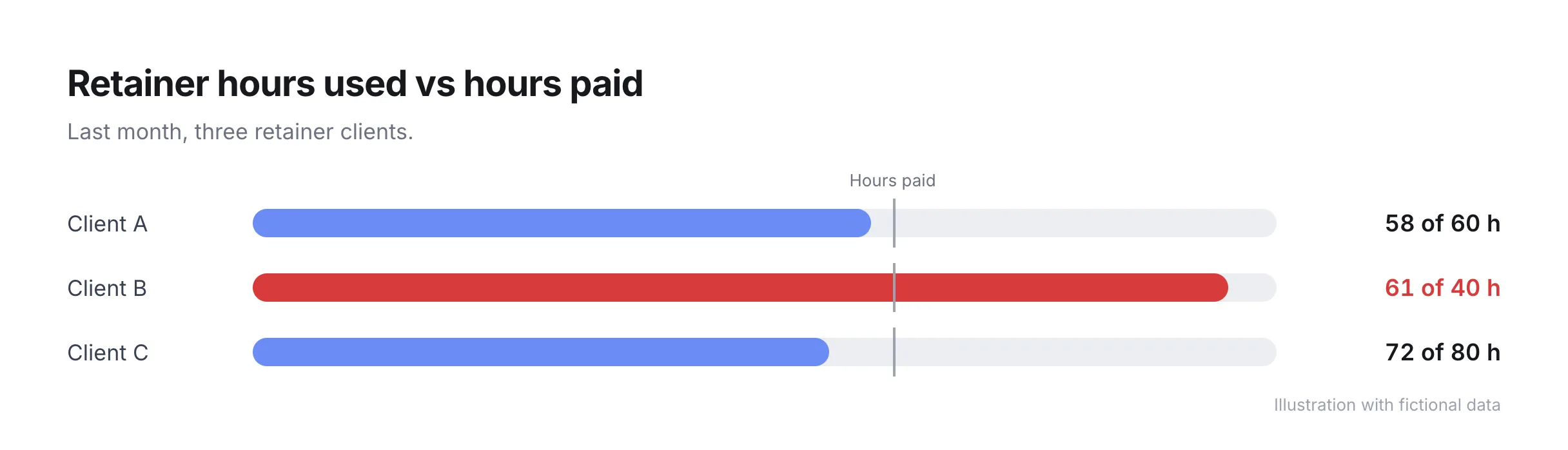
The effect on rate is direct. A $6,000 retainer for 40 hours is $150 an hour. Delivered in 61 hours, the same retainer is worth $98 an hour, and every hour past 40 is unpaid. The retainer management guide covers how to set allowances and handle overages, and the glossary entry on over-servicing explains the term in more detail.
Ad-hoc requests are the small asks that arrive outside the scope: an extra banner size, a quick report for the client's board, a landing page tweak. Each one takes an hour or two. Without a habit of logging them against the client and checking them against scope, they never reach an invoice or a change order.
Senior people doing work a junior could do costs margin twice: the client gets the same output at a higher cost rate, and the senior person is not available for work only they can do. Look at the hours by role for each client. When a strategy director logs a large share of a client's hours on production tasks, staffing is the problem, not pricing.
Hold a monthly review of margin by client, with the account leads and whoever owns finance. Keep it short and look at the same columns every time:
| Column | What to look for |
|---|---|
| Agency gross income | Change from last month and from the plan |
| Hours used vs hours paid (retainers) | Any client above 100% for two months in a row |
| Margin on AGI | Clients below your target margin |
| Effective rate | Clients well below your standard rate |
For each client below target, the account lead brings one of three proposals to the next meeting: raise the retainer, cut the scope back to what the retainer covers, or change who does the work. Clients below target for three months in a row go to a pricing conversation at renewal.
For the report itself, the guide to building a project profitability report covers the layout, and the same columns work per client.
Pike shows earnings, cost and profit for every project, calculated from logged hours, each person's cost rate and your invoices. Retainers, fixed fees and time-and-materials work each have their own billing type, and you can set budgets per cost category to track spend while the work runs. The Pike page for marketing agencies covers how retainer-heavy teams set it up, and the finance features show the profitability views.
See which of your clients are profitable this month, not at year-end: book a 15-minute walkthrough.
Measure margin against agency gross income, which is total billings minus pass-through costs such as ad spend. Calculate it per client each month: agency gross income minus delivery cost (hours times each person's cost rate, plus direct costs), divided by agency gross income.
Media spend counts as revenue on the invoice but goes straight to the media owner. Including it in revenue makes the margin percentage smaller without changing the profit. A client with $30,000 of media and $20,000 of agency income looks like a 14% margin client instead of a 35% one.
Agency gross income is the revenue an agency keeps for its own work: total billings minus pass-through costs such as media, printing and third-party fees billed at cost. It is the right base for margin, targets and comparing clients.
Track hours used against hours paid for every retainer each month, and agree in the contract what happens above the allowance. When a client goes over for two months in a row, raise it with them and either increase the retainer or reduce the scope.
Yes. Account management is part of the cost of serving the client, even when it is not billed by the hour. Leaving it out makes the most demanding clients look more profitable than they are.
Share
 ISO 27001
 GDPR
 SOC 2 Type II
Built to keep sensitive client data secure and private.