Best Resource Scheduling Software for Agencies (2026)
Share

"We keep double-booking resources because we don't have visibility into capacity." That is the sentence that shows up in a resource scheduling search once a team has grown past the point where one person can hold every assignment in their head. Resource scheduling software puts every person's calendar in one place: what they're already staffed on, when they're free, and whether assigning them to a new project creates a conflict before you commit to the client.
This guide compares the nine tools agencies and consultancies shortlist most often for scheduling in 2026. For each one, what its calendar and assignment tools actually do, where they fall short, and what they cost.
TL;DR
- Pike keeps one live schedule across every project a person is staffed on, so a conflict shows up before it becomes a missed deadline.
- Kantata matches people to work by role and skill, then books time against project accounting.
- Scoro gives a drag-and-drop Planner for day-by-day scheduling across the team.
- Productive syncs scheduling with time off and holidays automatically.
- Accelo flags scheduling conflicts with AI before they turn into delivery risk.
- Teamwork connects the team calendar to more than 150 other apps.
- Rocketlane auto-generates onboarding schedules from a signed statement of work.
- Asana gives cross-functional teams a shared timeline and calendar view.
- BigTime ties the schedule to billable-hour heatmaps for finance-first firms.
See your team's schedule in one place. Book a 15-minute walkthrough.
What resource scheduling software actually does
Resource scheduling software answers a narrower question than capacity planning does. Capacity planning asks whether the team has enough hours in total for the work ahead. Scheduling asks who is doing what, on which days, right now, and whether two projects just tried to claim the same person at the same time. Our capacity planning software guide covers the aggregate-availability question if that's the one you're solving; this guide is about the calendar-level tools that prevent double-booking.
A scheduling tool gives you a calendar or timeline view of every person's assignments, lets you drag a task onto a date and see immediately whether it conflicts with something else they're already booked on, and flags overlaps across teams and projects before a manager has to catch them by eye. Without that view, double-booking is usually discovered the way most agencies discover it: a project manager finds out mid-sprint that the designer they were counting on is also fully booked on another account that week.
What to look for in a resource scheduling tool
A real calendar or timeline view. Look for drag-and-drop scheduling by day or week, not a list of assignments you have to cross-reference manually. A useful tool shows every project a person touches on one screen.
Conflict and double-booking alerts. The tool should flag an overlap the moment you try to create it, not after the person has already logged hours to two accounts in the same slot. This is the feature that actually prevents the pain named at the top of this guide.
Skill and role matching. Scheduling by name only works at small scale. Past a certain headcount, you need to filter by role or skill so a scheduler can find someone who's both free and qualified for the work.
Cross-team and cross-project visibility. A consultant working across three client engagements needs their availability visible from all three, not tracked separately in three project plans that disagree with each other.
Integration with the tools you already run. Check whether the schedule syncs with your calendar app, project management tool, and time tracking, so an assignment made in one place doesn't have to be re-entered in another.
Comparison table
Starting prices are the vendors' public list prices as of 2026. Where a vendor does not publish pricing, we show contact sales.
| Tool | Best for | Starting price | Core scheduling feature |
|---|---|---|---|
| Pike | Agencies scheduling across accounts | From $29/user/month | One live schedule per person across every staffed project |
| Kantata | Large services firms | $69/user/month | Role and skill-based scheduling tied to project accounting |
| Scoro | Visual, day-by-day scheduling | $10/user/month | Drag-and-drop Planner across the whole team |
| Productive | Mid-sized agencies | $9/person/month annually | Calendar scheduling synced with time off and holidays |
| Accelo | Client-services firms | Contact sales | AI-flagged scheduling conflicts |
| Teamwork | Integration-heavy agencies | $10.99/user/month | Team calendar connected with 150+ apps |
| Rocketlane | Onboarding and implementation teams | Contact sales | Auto-generated schedules from signed statements of work |
| Asana | Cross-functional teams | $10.99/person/month annually | Shared timeline and calendar across projects |
| BigTime | Finance-first firms | $20/person/month | Scheduling tied to billable-hour heatmaps |
1. Pike
Best for: agencies and consultancies scheduling people across multiple overlapping client engagements.
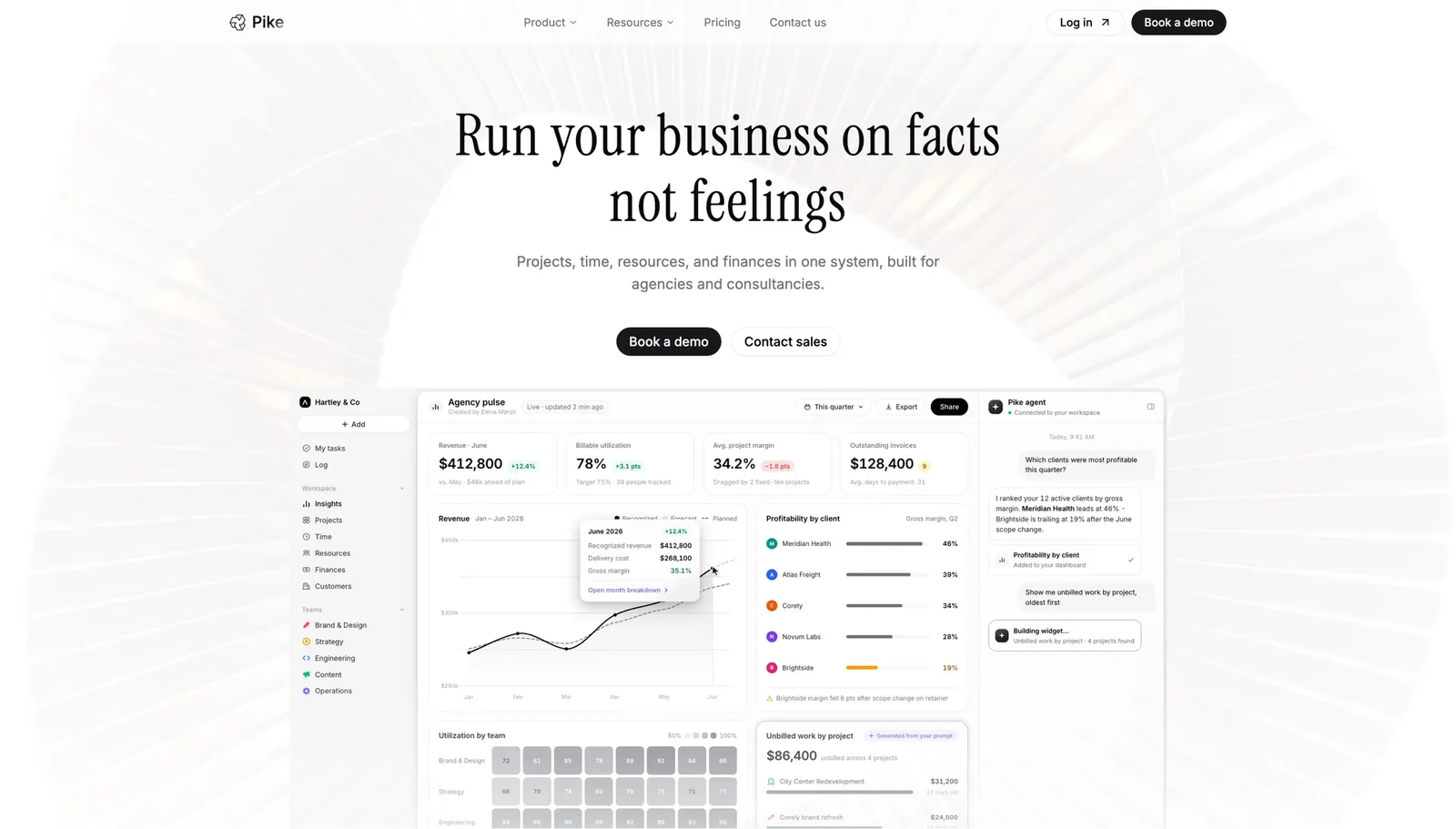
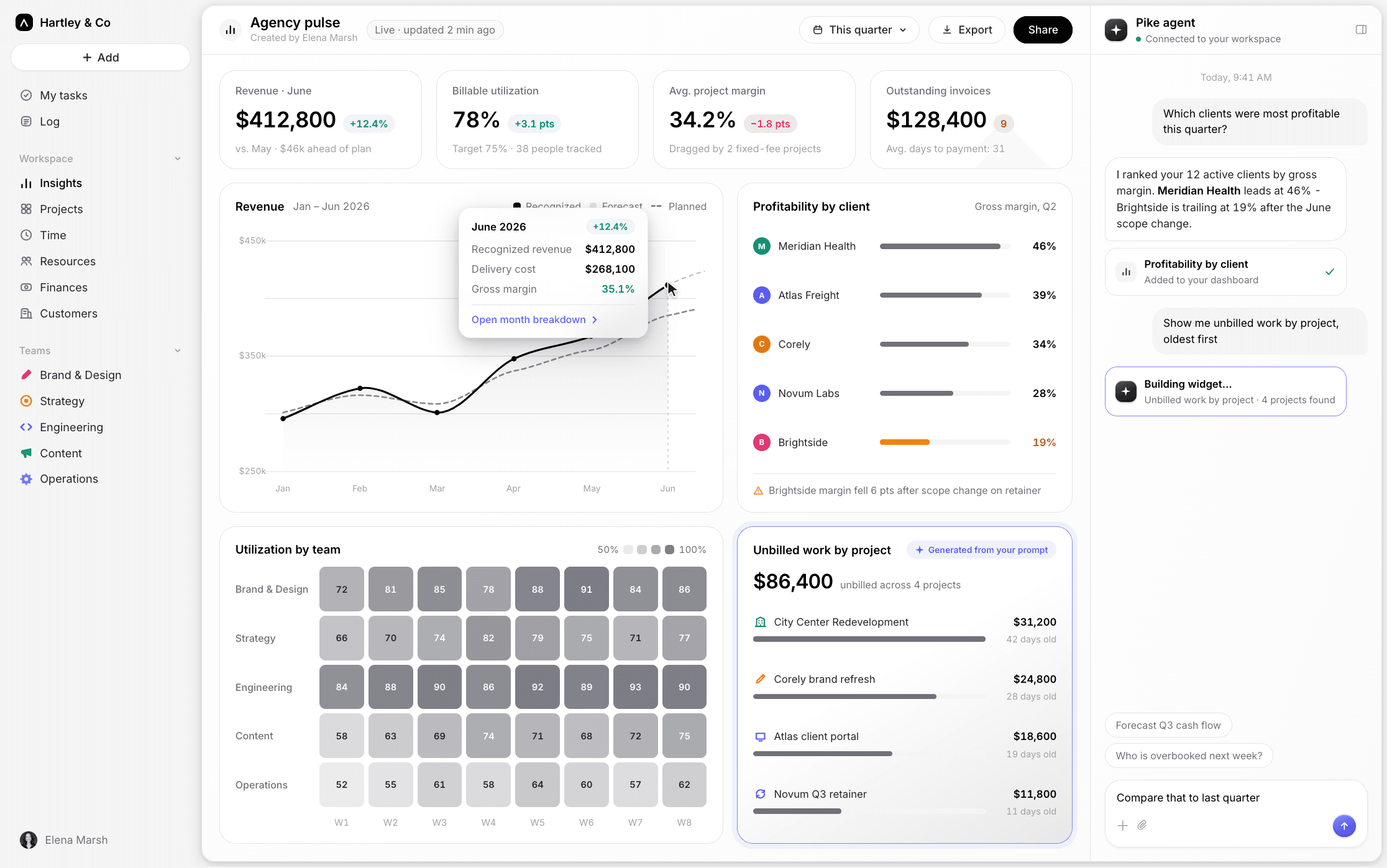
Pike keeps one schedule per person, not one schedule per project. When someone is staffed on a new engagement, that assignment shows up against everything else they're already booked on, so a scheduling conflict is visible the moment it's created instead of discovered mid-delivery.
Pike runs 4 billing models (fixed-price, time-and-materials, capped T&M, and retainer) and syncs with 4 accounting systems (QuickBooks, Xero, Business Central, and E-conomic), so a schedule change carries through to billing without a separate update. It's in production at teams including Outerkind, McElroy Architecture, e&enterprise, WPP, and Veolia.
Pros
- One schedule per person across every project catches double-booking before it happens, not after.
- Skill and role filters help a scheduler find who's actually free and qualified.
- Scheduling, time tracking, and billing stay in the same system, so an assignment change doesn't need re-entry elsewhere.
Cons
- Team-wide scheduling dashboards sit on the Growth plan and above, not the entry Core tier.
- Firms outside professional services won't need its agency-specific billing model.
Pricing: Pike publishes plans starting at $29 per user per month (Core, billed annually; $35 monthly), with Growth at $49 and Scale at $99 per user per month, plus a custom Enterprise tier. See pricing or book a walkthrough.
2. Kantata
Best for: large professional services firms that need to schedule by skill, not just by name.
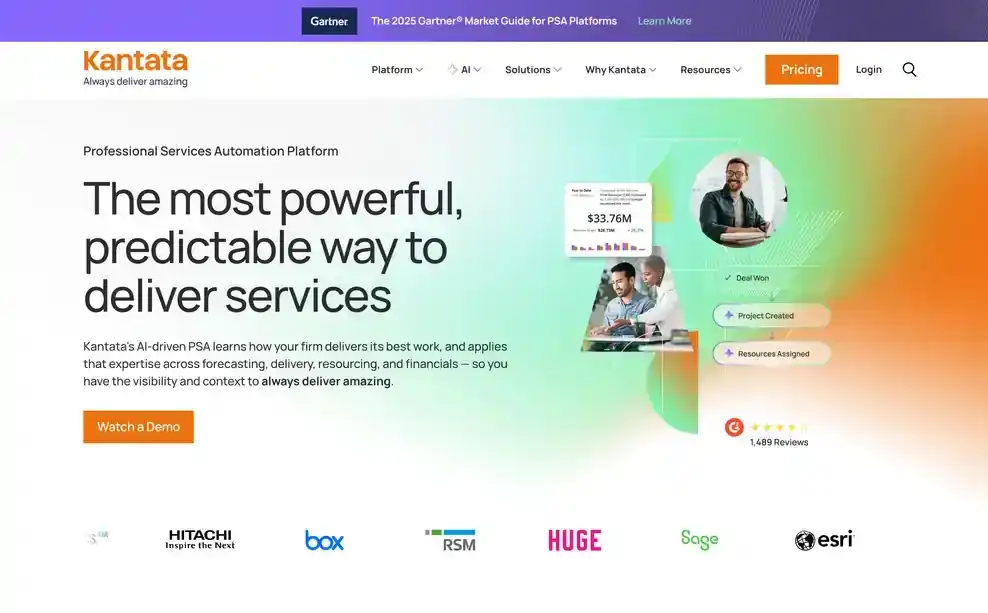
Kantata matches people to work using role and skill data, then ties the resulting schedule to project accounting so a staffing decision shows its budget impact immediately. It integrates with Salesforce and Google Workspace, which cuts down on duplicate scheduling entries for firms already running on those tools.
Pros
- Role and skill-based matching goes beyond scheduling by name.
- Scheduling changes flow directly into project accounting.
- Salesforce integration fits an established professional services stack.
Cons
- Firms on a different CRM get less value from the Salesforce-native workflow.
- Its scope and cost typically exceed what a small agency's scheduling needs justify.
Pricing: Kantata does not publish standard pricing. Contact its sales team for a custom quote. See Kantata vs Pike.
3. Scoro
Best for: agencies that want a fully visual, drag-and-drop scheduling calendar.
Scoro's Planner is a day-by-day, drag-and-drop calendar for the whole team, built so a scheduler can see and move assignments without leaving the calendar view. It also flags when a proposed assignment would push someone over their available hours for that day, which catches overbooking at the point of scheduling rather than after the fact.
Pros
- The Planner makes rescheduling a drag-and-drop action instead of a form to fill out.
- Overbooking warnings appear while you're still building the schedule.
Cons
- Scoro can cost more than a lighter, scheduling-only tool.
- The broader PSA feature set around the Planner takes more setup than a dedicated calendar app.
Pricing: Scoro does not publish a verified public starting price for the tier that includes these features. Contact Scoro for current pricing. See Scoro vs Pike.
4. Productive
Best for: mid-sized agencies that need scheduling to account for time off automatically.
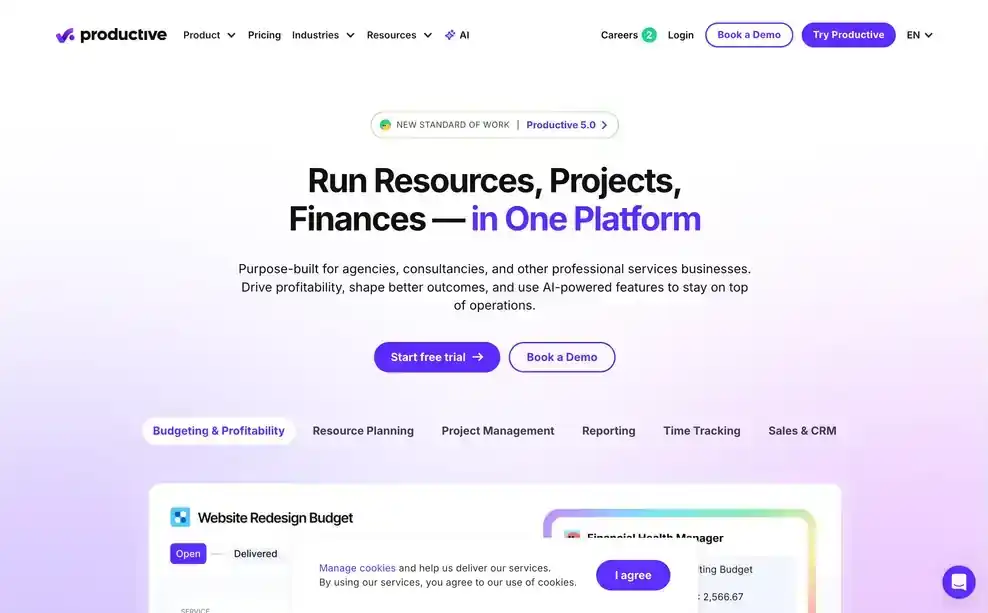
Productive's scheduling view factors in booked time off and holidays automatically, so a scheduler isn't cross-checking a separate leave calendar before confirming an assignment. It shows each person's committed hours against their available hours for the week directly in the scheduling view.
Pros
- Time off and holidays are built into the same view as project assignments.
- Weekly committed-versus-available hours are visible without a separate report.
Cons
- Customising the scheduling view for less common reporting needs is limited.
- The broader platform has a steeper learning curve than a scheduling-only tool.
Pricing: Plans start at $9 per person per month billed annually. See Productive vs Pike.
5. Accelo
Best for: client-services firms that want scheduling conflicts flagged automatically.

Accelo's predictive tools review the schedule and flag a likely conflict or overbooking before it happens, rather than leaving a manager to spot it manually. That review runs against live project and time data, so the flag reflects the current schedule, not a plan from last week.
Pros
- AI flags likely scheduling conflicts and overbooking ahead of time.
- Conflict checks run against current project and time data, not a static plan.
Cons
- The narrow professional-services focus limits its fit for general scheduling needs.
- Flagged conflicts still need a human to decide how to resolve them.
Pricing: Accelo does not publish pricing. Contact its sales team for a quote. See Accelo vs Pike.
6. Teamwork
Best for: agencies that want the team calendar connected to a large integration library.
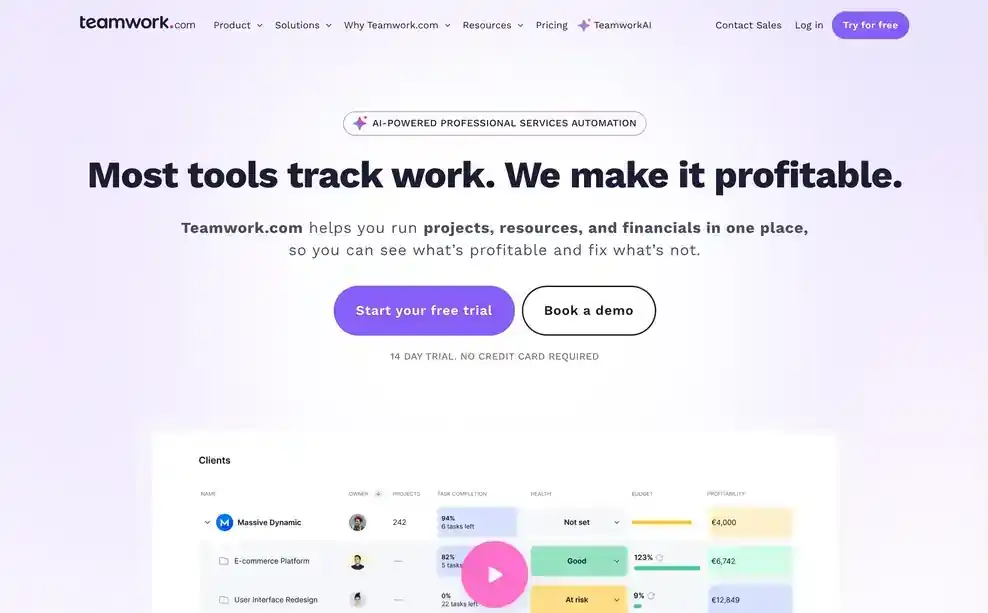
Teamwork's calendar and workload views sit alongside more than 150 integrations, which suits agencies that want scheduling changes to reach the finance, communication, and reporting tools they already use without a manual export.
Pros
- Calendar and workload views cover the basics of day-to-day scheduling.
- More than 150 integrations connect the schedule to the rest of the stack.
Cons
- Smaller agencies can find the surrounding feature set complex to configure just for scheduling.
- Conflict detection is less automatic than in tools built specifically around it.
Pricing: Contact Teamwork for pricing that includes the scheduling features. See Teamwork vs Pike.
7. Rocketlane
Best for: onboarding and implementation teams that want a schedule generated automatically from a signed contract.

Rocketlane can turn a signed statement of work into a scheduled project plan without someone rebuilding the timeline by hand, which matters most for teams that run the same onboarding motion repeatedly and want the schedule set up the same way every time.
Pros
- Schedules generate automatically from a signed contract instead of manual setup.
- Repeatable onboarding schedules stay consistent across engagements.
Cons
- The onboarding focus limits its fit for scheduling broader, less repeatable agency work.
- Heavy automation can get in the way of a schedule that needs frequent manual adjustment.
Pricing: Rocketlane does not publish a verified starting price. Contact sales for current pricing.
8. Asana
Best for: cross-functional teams that need a shared calendar more than dedicated conflict detection.
Asana's timeline and calendar views let a scheduler see assignments across concurrent projects on one screen. Custom fields can carry effort or time estimates, which helps a scheduler spot an obvious overlap, though the check is manual rather than automatic.
Pros
- Timeline and calendar views work across projects that live outside client-services work too.
- Custom fields make rough overlaps visible to anyone reviewing the schedule.
Cons
- There's no automatic double-booking alert; a person still has to check.
- Deeper scheduling and skill-matching features aren't part of the core product.
Pricing: Plans with basic timeline and calendar features start at $10.99 per person per month billed annually. See Asana vs Pike.
9. BigTime
Best for: finance-first professional services firms that want the schedule tied to billable-hour data.

BigTime's colour-coded heatmaps show scheduled and booked hours side by side, so an overbooked week is visible at a glance and tied directly to what those hours will bill. Scenario planning lets you test a proposed schedule change against pipeline work before committing to it.
Pros
- Heatmaps make an overbooked week visually obvious.
- Scheduling ties directly to billable-hour and pipeline data.
Cons
- Deeper scheduling features require higher-tier plans.
- Initial setup and training take longer than a scheduling-only tool.
Pricing: BigTime starts at $20 per person per month. Confirm which tier includes scenario planning and heatmaps.
Which tool fits your agency
- Small, cross-functional team. Asana works if a shared calendar is enough and you don't need automatic conflict alerts.
- 25 to 30-person creative agency. Pike or Scoro both give day-level scheduling with conflict visibility across every active project.
- Firm scheduling by skill, not just by name. Kantata's role and skill matching fits once headcount makes name-based scheduling unreliable.
- Salesforce-native team. Kantata again, for the CRM-integrated scheduling workflow.
- Onboarding-heavy business. Rocketlane fits teams whose scheduling need is mostly repeatable client onboarding.
- Finance-first firm. BigTime ties scheduling directly to billable-hour reporting.
Why agencies choose Pike for scheduling
Agencies choose Pike because a person's schedule is one thing, not a separate plan per project that someone has to reconcile by hand. When a project manager staffs someone new, that assignment shows up immediately against everything else the person is already booked on, so a double-booking is visible before it's committed rather than discovered once two clients are expecting the same hours. Pike keeps resourcing and scheduling in the same view as finance, so a scheduling decision shows its billing impact at the same time.
See your team's schedule in one place, book a 15-minute walkthrough.
How we evaluated these tools
We assessed each product against the five areas above: calendar and timeline view, conflict and double-booking alerts, skill and role matching, cross-team visibility, and integration with existing tools, along with fit for agencies and professional services firms.
Public vendor pages supplied feature and pricing details. Where a vendor did not publish pricing, we marked it contact sales. Each entry names one real limitation alongside its strengths.
Frequently asked questions
Share